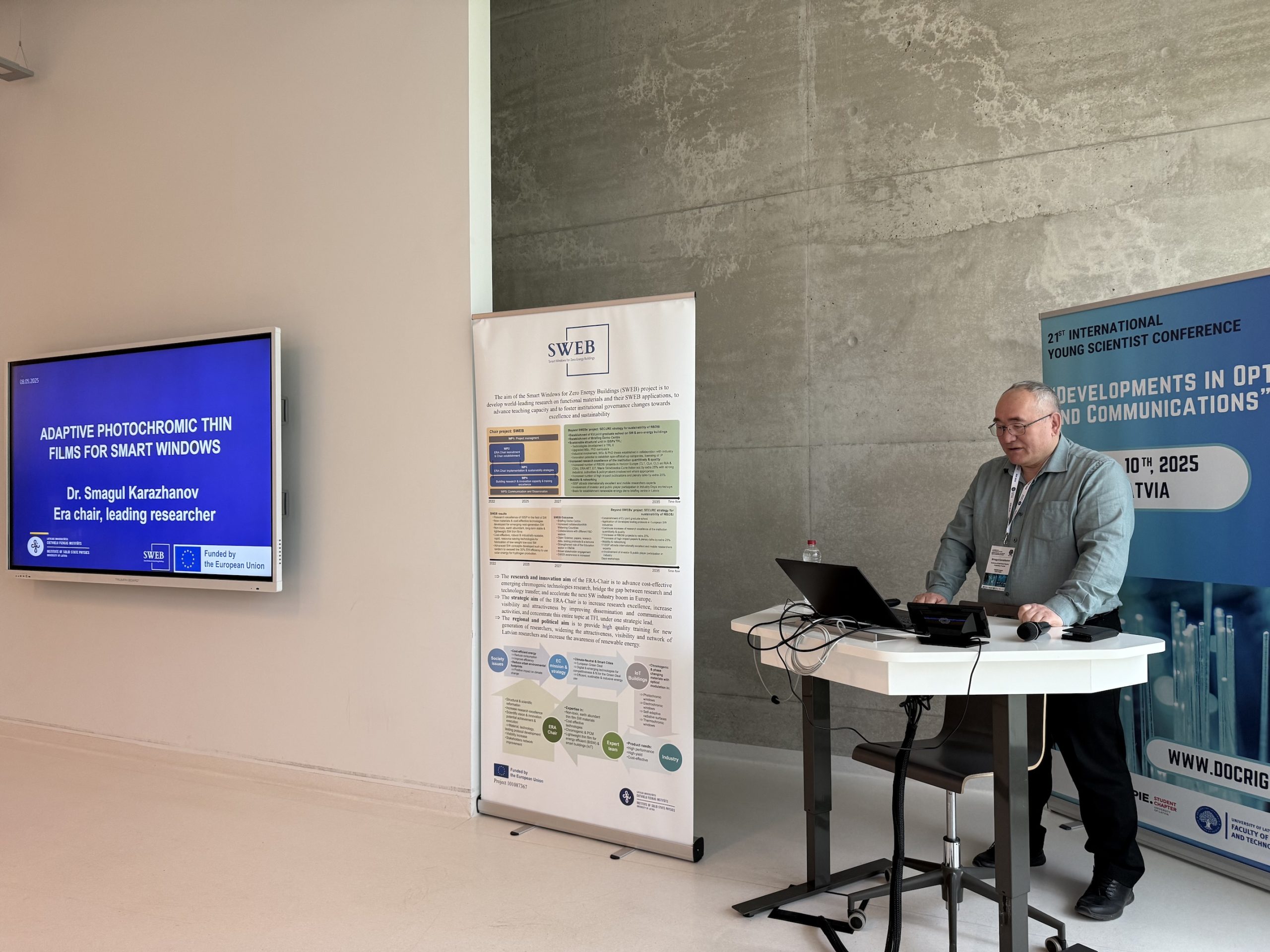
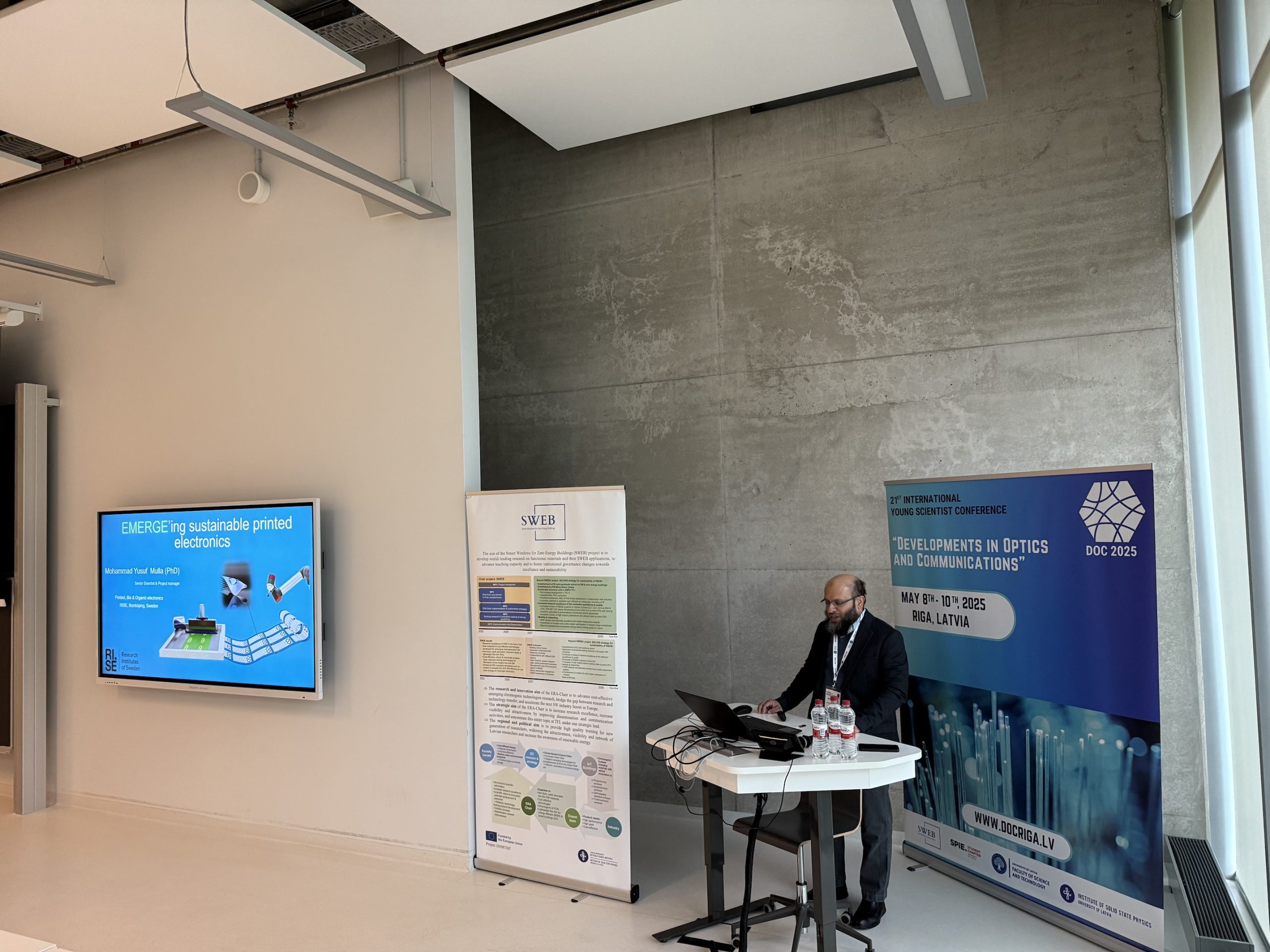
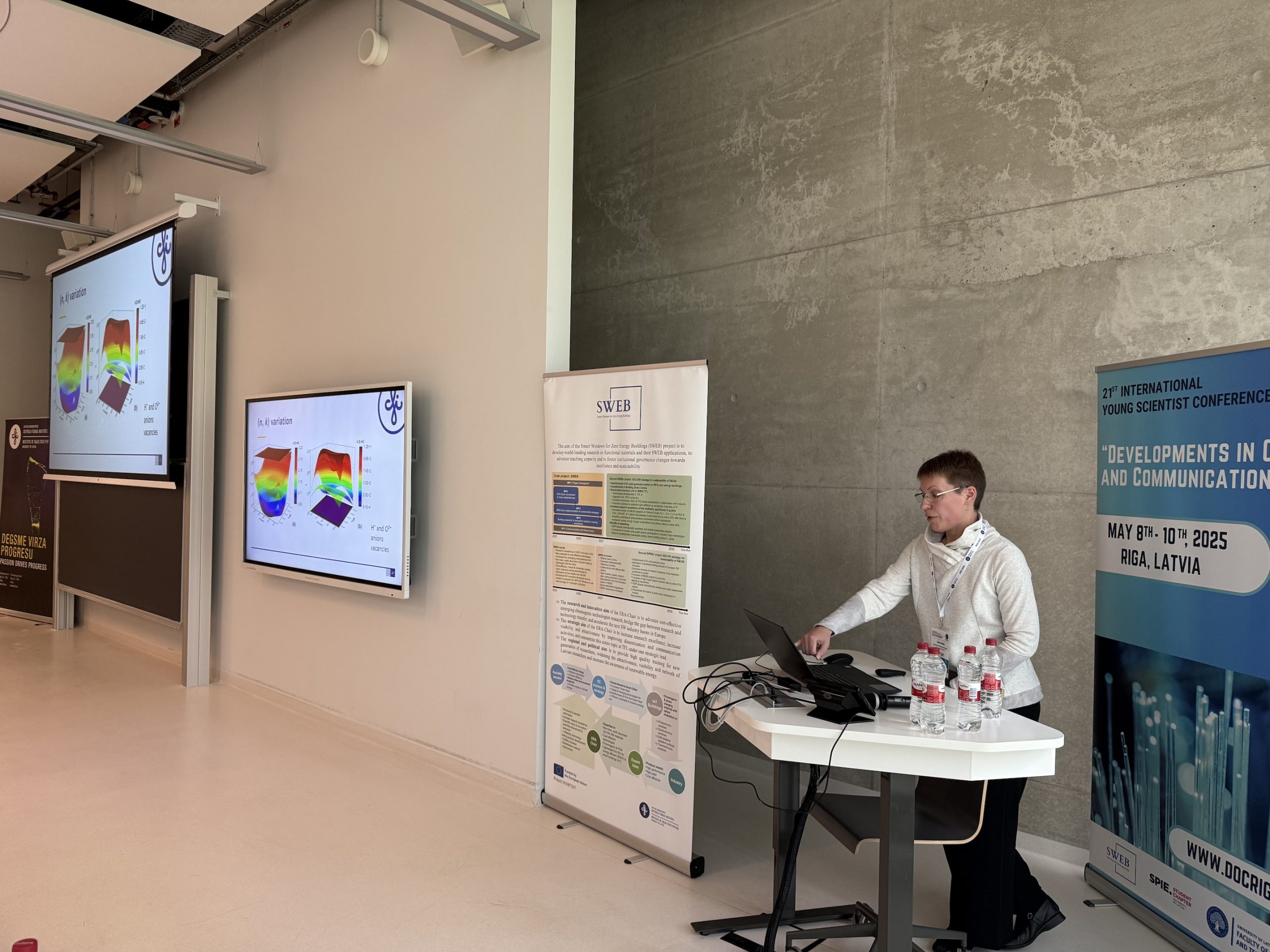
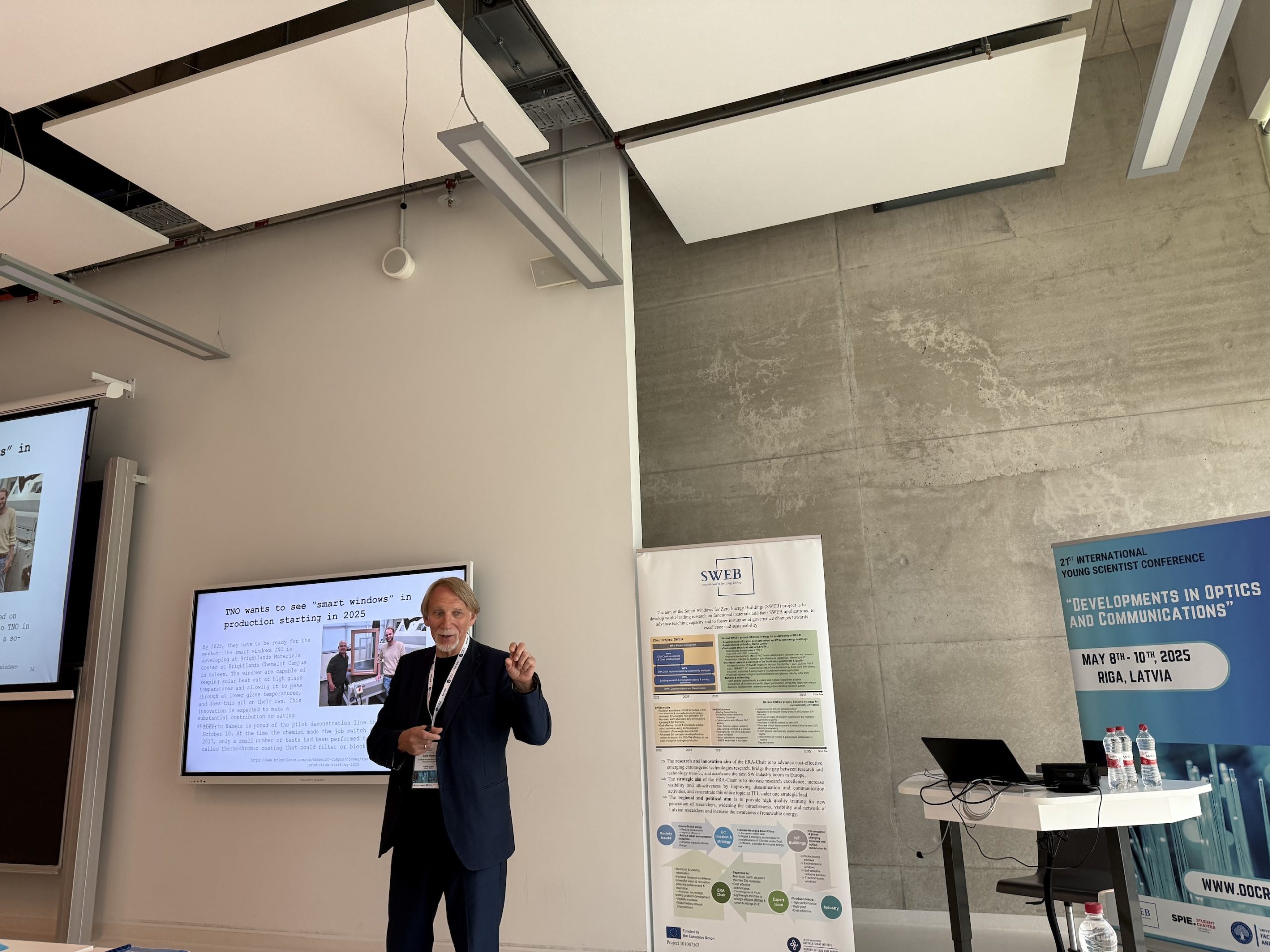
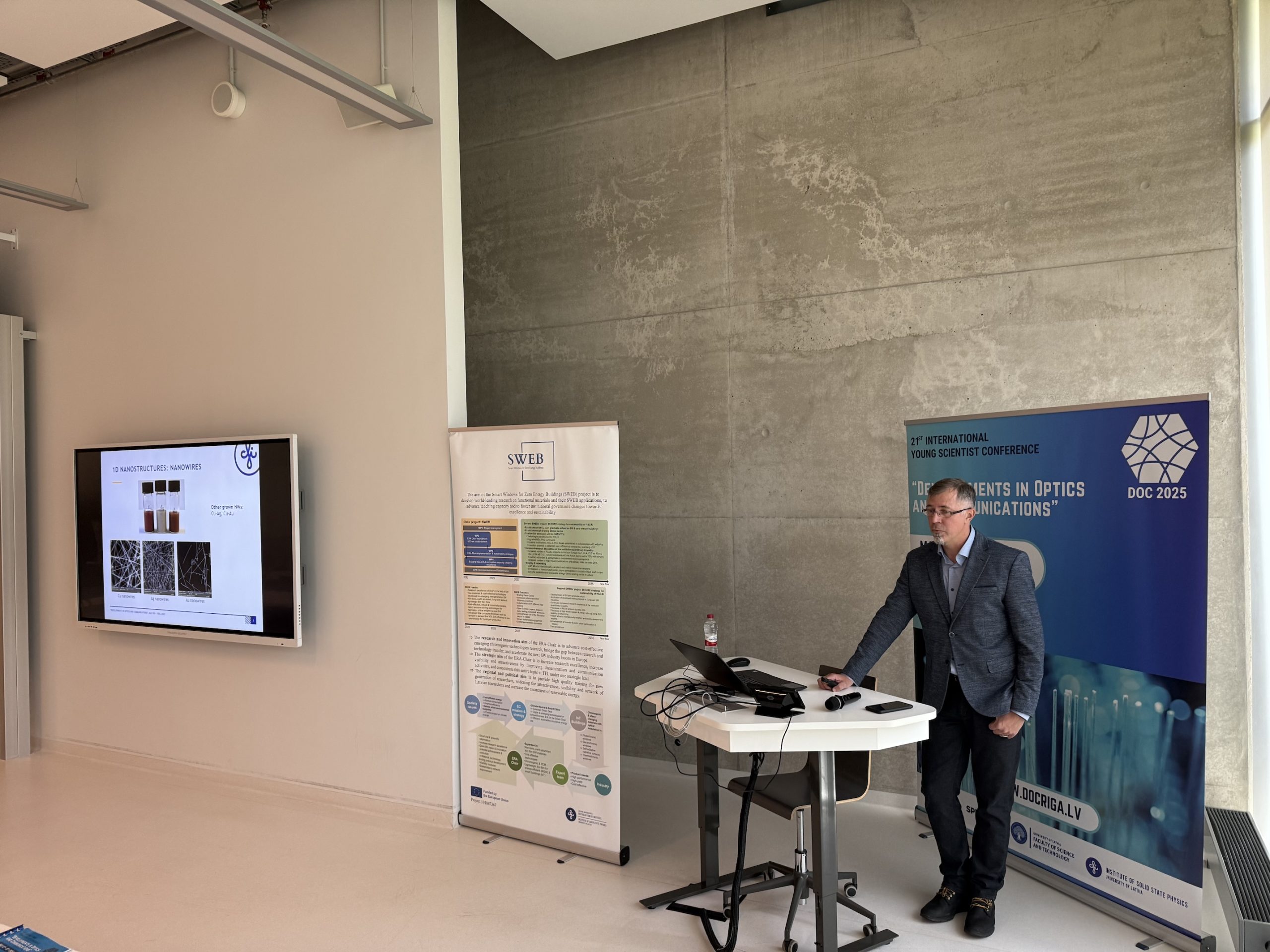
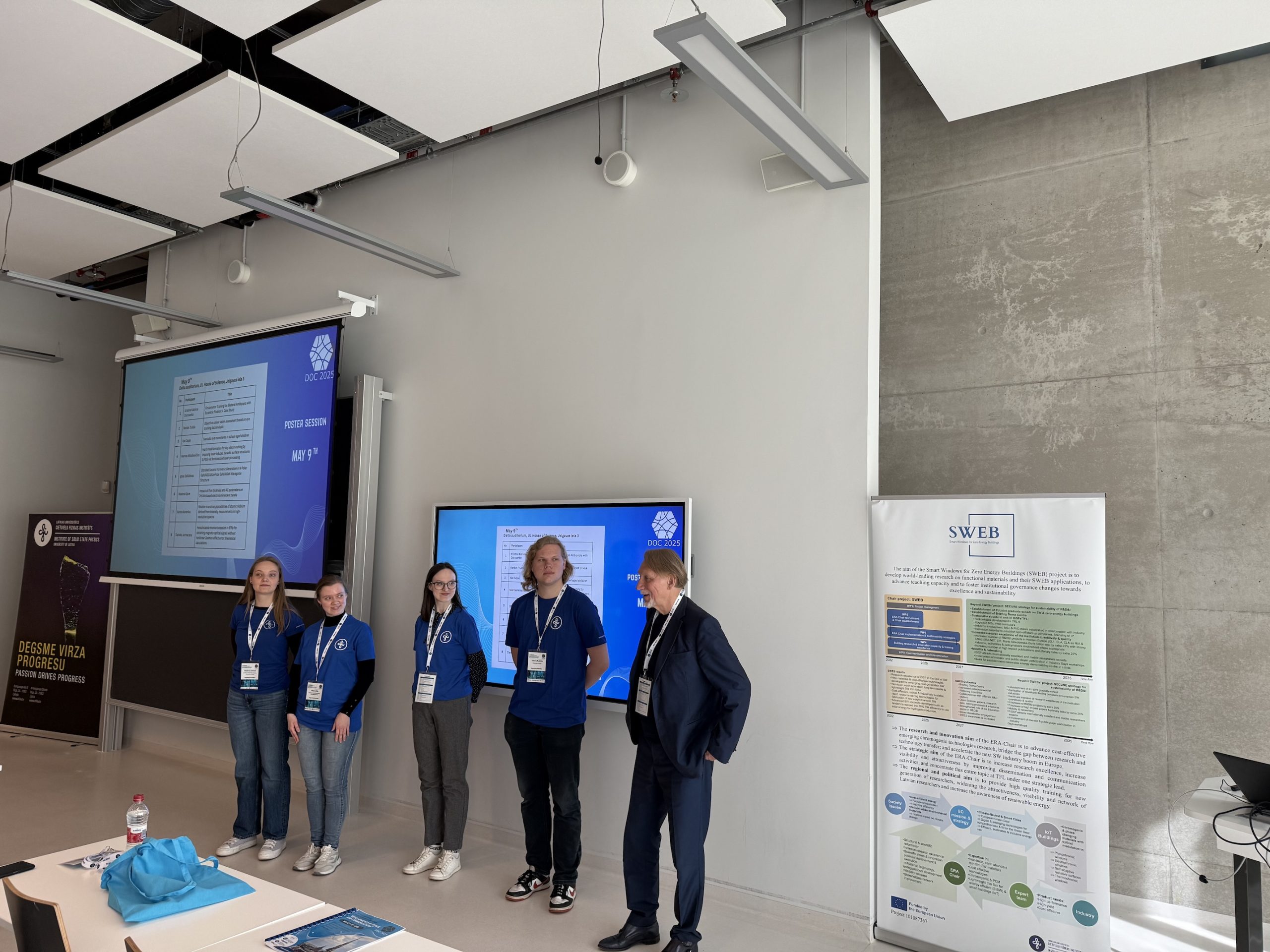
On 8 May 2025, the SWEB team co-organised and participated in the 21st International Young Scientist Conference on Developments in Optics and Communications (DOC 2025) in Riga. Held in the Delta Auditorium of the University of Latvia’s House of Science, the session “Smart Windows for Zero Energy Buildings” brought together students and early-career researchers to explore advances in adaptive zero energy building technologies and discuss how to bring these innovations out of the lab and into real-world use.
Dr. Juris Purāns opened the session with a clear overview of adaptive chromogenic materials. He described how his team has created coatings whose colour and transparency change when an electric voltage is applied, helping buildings manage heat and daylight with minimal energy use. By sharing performance measurements alongside stories of early experimental setbacks, he showed both the promise of the technology and the careful testing that underlies every successful development.
Next, Dr. Boris Polyakov presented on functional nanomaterials designed for additive manufacturing. He explained how custom nanocomposite inks can be 3D-printed into complex window elements tailored to a building’s orientation and climate. His examples connected the precision of nanoscience with the flexibility of modern printing methods, illustrating a smooth path from material design to practical fabrication.
After a short break, Dr. Smagul Karazhanov and Dr. Ilze Aulika offered two linked talks on photochromic thin films and their analysis. Dr. Karazhanov discussed sustainably printed films that darken under sunlight and clear in low light without any external power source. Dr. Aulika then explained how spectroscopic ellipsometry reveals the films’ internal structure and optical properties, giving researchers the data they need to optimize switching speed and durability.
In their closing remarks, the SWEB team outlined the project’s goals: mapping a clear development plan, building researchers’ communication and teamwork skills, and strengthening partnerships across disciplines and industry. They also invited attendees to apply for the upcoming SWEB Summer School on “Solar Energy Materials and Smart Devices,” which will take place 18–20 June 2025 at the Institute of Solid State Physics, University of Latvia. This three-day programme will combine hands-on workshops, expert talks, and networking sessions to give young scientists the tools they need to turn smart-window research into real-world solutions.
Photo Gallery